
Microarchitectural Research

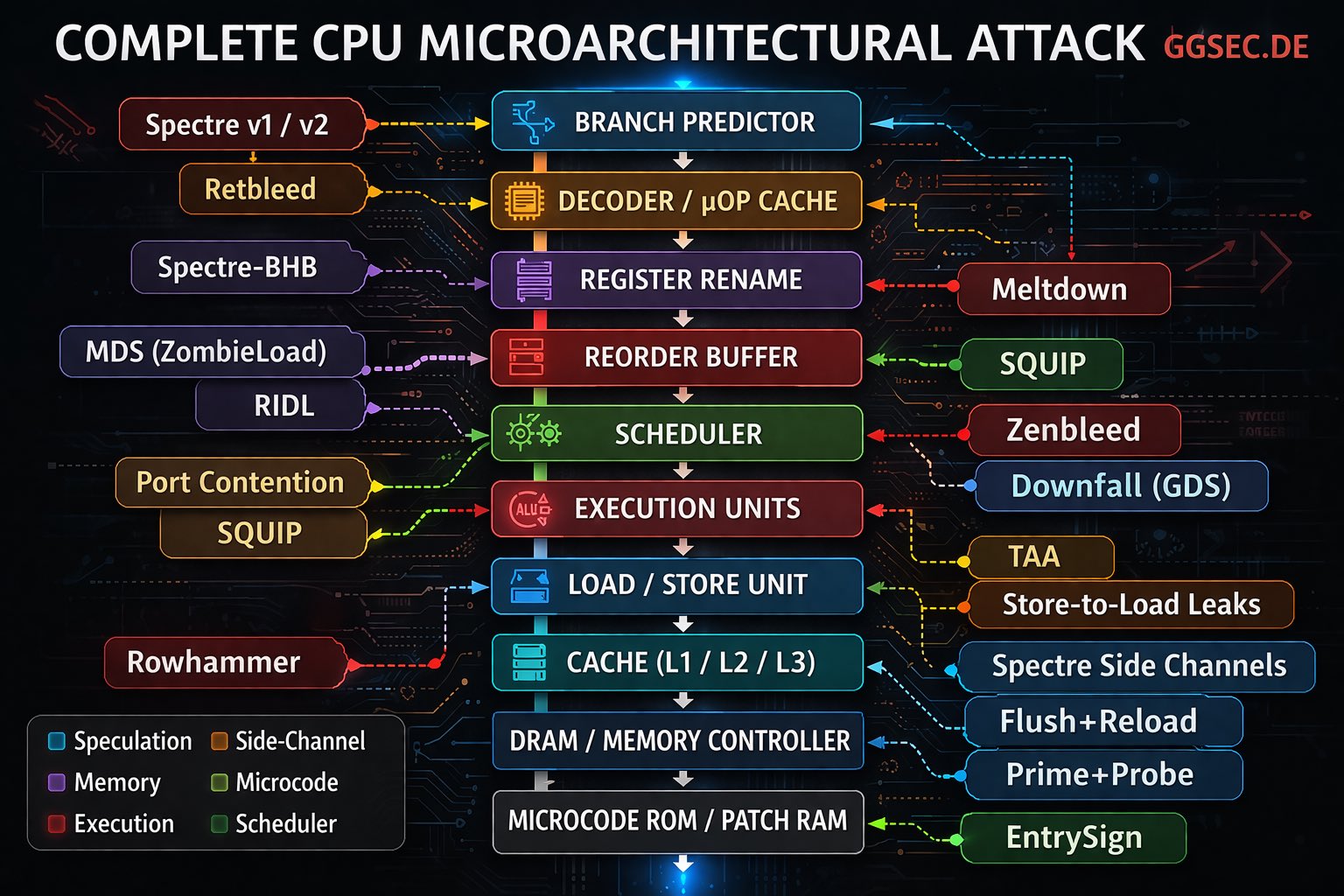
Complete CPU Microarchitectural Attack Surface

Spectre · Meltdown · MDS · Zenbleed · Downfall · Rowhammer — The full taxonomy of transient execution and side-channel vulnerabilities.

This page provides a structured view of transient execution, side-channel, scheduler, cache, DRAM, and processor trust-boundary attack classes, with emphasis on practical security assessment and low-level validation work.

  • Branch Predictor → DRAM → Microcode
  • Component-focused taxonomy
  • Research, validation, mitigation review
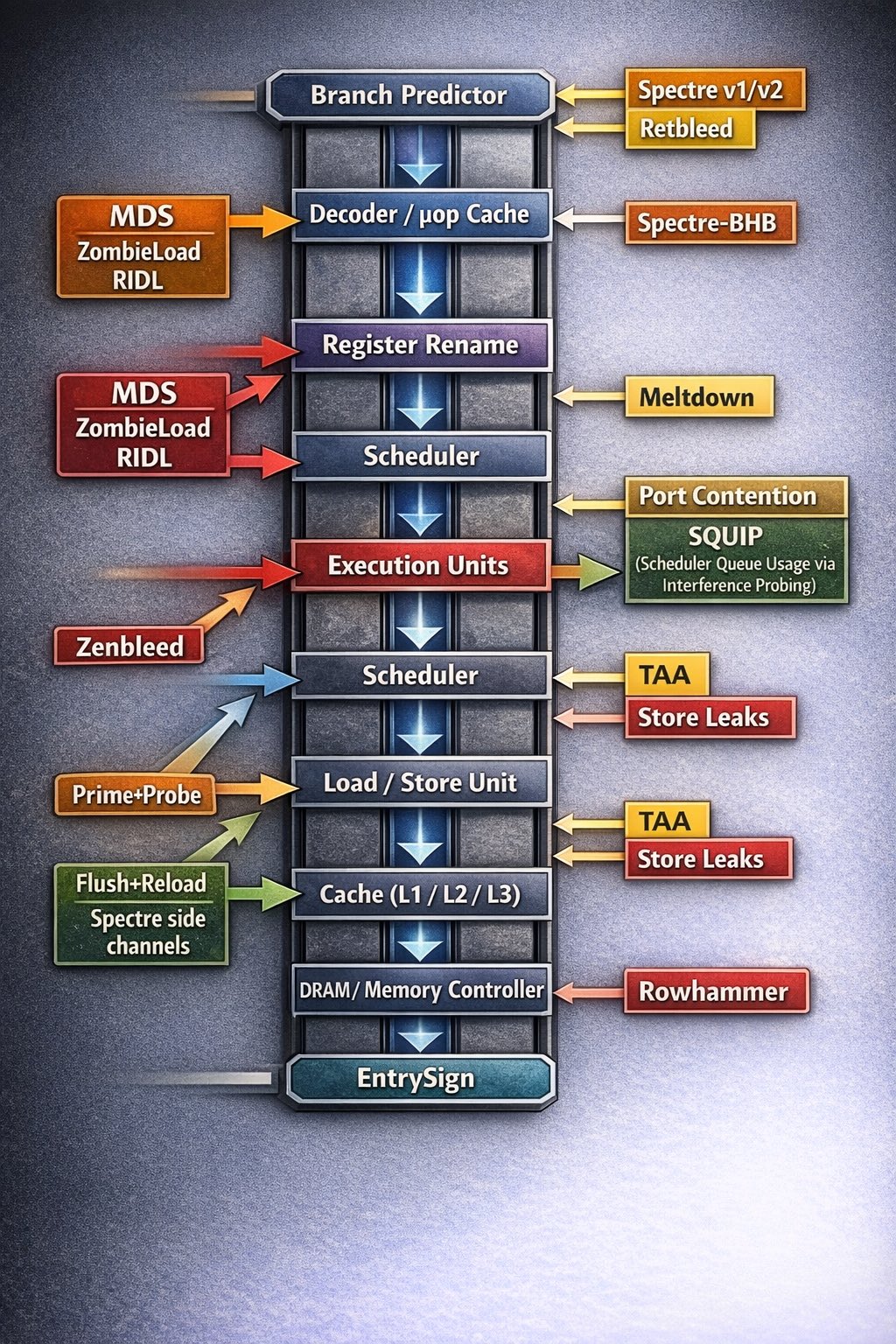
CPU microarchitectural attack map – component view Complete CPU Microarchitectural Attack Diagram – GGSEC branding

Audience

This material is intended for hardware security teams, security researchers, platform vendors, embedded system operators, and organizations evaluating modern CPU attack surfaces.

It is especially relevant where speculative execution, shared execution resources, firmware trust, or low-level processor isolation must be assessed in detail.

Assessment Focus

The goal is not only to list public attacks, but to map them to affected internal components and to support exploitability analysis, mitigation verification, and architecture-aware review.

This makes the page useful both as a taxonomy reference and as an entry point to consulting, validation, and research support.

Pipeline-Oriented View

Branch Prediction and Front‑End

Speculative execution issues in branch prediction logic can redirect transient control flow and expose data across privilege, process, or virtualization boundaries.

  • Spectre v1 — bounds check bypass affecting speculative paths.
  • Spectre v2 — branch target injection through predictor poisoning.
  • Retbleed — return prediction abuse in return-oriented transient execution.
  • Spectre‑BHB — branch history manipulation across protection domains.

Decode, Rename, and Internal Buffers

Instruction decode, micro‑op handling, register renaming, and internal buffers remain relevant to transient leakage and state exposure research.

  • ZombieLoad (MFBDS) — Microarchitectural Fill Buffer Data Sampling (CVE‑2018‑12130).
  • RIDL (MLPDS / MSBDS) — Microarchitectural Load Port / Store Buffer Data Sampling.
  • Meltdown — out‑of‑order execution bypassing permission checks.

Scheduler and Execution Units

Out‑of‑order scheduling and execution resources can act as both leakage sources and contention‑based side channels.

  • SQUIP — scheduler queue contention side‑channel (AMD / Apple).
  • Zenbleed — vector register leakage on AMD Zen 2 (CVE‑2023‑20593).
  • Downfall / GDS — Gather Data Sampling on Intel (CVE‑2022‑40982).
  • Port contention — covert channel via execution port pressure.

Load/Store, Cache, and DRAM

Memory disambiguation, forwarding behavior, and cache timing effects are central to many practical side‑channel and transient execution attacks.

  • TAA (TSX Asynchronous Abort) — CVE‑2019‑11135.
  • SRBDS (Special Register Buffer Data Sampling) — CVE‑2020‑0543.
  • L1TF / Foreshadow — L1 cache leakage (CVE‑2018‑3615).
  • Flush+Reload / Prime+Probe — cache timing techniques.
  • Rowhammer — DRAM disturbance errors (CVE‑2015‑0565+).

Microcode and Trust Boundaries

Processor trust does not end with speculative execution and cache behavior. Microcode delivery, verification, patch loading, and update‑chain integrity are also part of the attack surface in advanced hardware security work.

This research area includes microcode verification bypass topics, processor persistence implications, signature and update‑path trust analysis, and firmware‑adjacent validation of low‑level protection mechanisms.

Attack Category CVE / Year Affected Component Vendors
Spectre v1Speculative ExecutionCVE‑2017‑5753Branch PredictorIntel, AMD, ARM
Spectre v2Speculative ExecutionCVE‑2017‑5715Branch PredictorIntel, AMD, ARM
MeltdownOut‑of‑Order ExecutionCVE‑2017‑5754Memory / OoO EngineIntel, ARM (some)
RetbleedReturn PredictionCVE‑2022‑29900 / 29901Return Stack / Branch LogicIntel, AMD
Spectre‑BHBBranch History InjectionCVE‑2022‑0001 / 0002Branch History BufferIntel, AMD, ARM
ZombieLoad (MFBDS)MDSCVE‑2018‑12130Fill BuffersIntel
RIDL (MSBDS)MDSCVE‑2018‑12126Store BuffersIntel
RIDL (MLPDS)MDSCVE‑2018‑12127Load PortsIntel
L1TF / ForeshadowL1 Cache LeakageCVE‑2018‑3615L1 Data CacheIntel
TAA (TSX Async Abort)Transactional MemoryCVE‑2019‑11135Transactional MemoryIntel
SRBDSRegister Data SamplingCVE‑2020‑0543Special RegistersIntel
ZenbleedRegister LeakageCVE‑2023‑20593Vector Register HandlingAMD (Zen 2)
Downfall (GDS)Gather Data SamplingCVE‑2022‑40982Gather InstructionsIntel
SQUIPScheduler ContentionCVE‑2023‑20584Scheduler / Shared QueuesAMD, Apple
RowhammerDRAM DisturbanceCVE‑2015‑0565+DRAM Row BufferAll (DRAM-dependent)
Microcode ResearchProcessor Trust / Update PathResearchMicrocode ROM / PatchIntel, AMD
GGSEC Research and Assessment Scope

Microarchitectural Review, Validation, and Mitigation Analysis

GGSEC provides microarchitectural vulnerability assessments, transient execution PoC validation, firmware-level mitigation review, and processor trust-surface analysis for advanced security environments.

Typical work includes attack-surface mapping across CPU pipeline components, exploitability validation, mitigation verification, regression review, and support for internal security programs or responsible disclosure workflows.

  • Attack‑surface mapping across internal CPU components
  • PoC review and exploitability validation
  • Mitigation verification and regression analysis
  • Firmware and microcode trust‑boundary review
  • Encrypted communication available, PGP supported