Executive Summary
The Unified Extensible Firmware Interface (UEFI) has replaced legacy BIOS as the industry-standard firmware interface for x86, x64, and ARM platforms. While UEFI brings significant security improvements — Secure Boot, cryptographic verification, and a standardized architecture — it also introduces a dramatically expanded attack surface.
UEFI firmware executes before the operating system, before any security agent loads, and before most hardware-based attestation begins. A compromise at this layer provides the attacker with:
- Persistence that survives OS reinstalls, disk replacements, and factory resets
- Stealth invisible to all OS-level security tools (EDR, AV, HIDS)
- Privilege equivalent to hypervisor or System Management Mode (SMM)
- Control over boot process, Secure Boot policy, and hardware initialization
1.1 Business Impact
| Impact Area | Consequences |
|---|---|
| Operational | Persistent compromise across fleet; remediation requires physical reflashing or motherboard replacement |
| Financial | Firmware incidents carry materially higher remediation cost than OS-level compromise, driven by per-device physical handling, specialist tooling and possible hardware replacement. GGSEC does not publish a point estimate; scope cost against fleet size and device accessibility. |
| Compliance | PCI DSS, HIPAA, FedRAMP violations due to inability to attest boot integrity |
| Reputational | Loss of customer trust when bootkits are discovered in production environments |
UEFI Architecture Overview
2.1 UEFI Boot Phases
Bootkit Architecture & Capabilities
3.1 What is a UEFI Bootkit?
A UEFI bootkit is malicious code that resides in the SPI flash storage (firmware) and executes during the UEFI boot process, before the OS loads. Unlike traditional bootkits that resided on disk (MBR/VBR) and were removed during OS reinstallation, UEFI bootkits survive all software-based remediation.
3.2 Bootkit Insertion Vectors
| Insertion Vector | Privilege Required | Persistence | Detectability |
|---|---|---|---|
| SPI flash write | Kernel/System (Ring 0) | Permanent until reflash | Medium |
| UEFI capsule update | Admin/Platform owner | Permanent | Low |
| Runtime variable | Kernel (Ring 0) | Survives reboot | High |
| Option ROM | PCIe device vendor | Per-device | Medium |
| SMM callout | Ring 0 + SMI handler | Firmware persistent | Low |
3.3 Bootkit Capability Matrix
| Capability | MBR Bootkit | UEFI Bootkit | UEFI Firmware Bootkit |
|---|---|---|---|
| Survives OS reinstall | ✓ | ✓ | ✓ |
| Persists after disk format | ✗ | ✓ | ✓ |
| Survives firmware update | ✗ | ✗ | ✓ (if not properly signed) |
| Invisible to EDR/AV | Partial | ✓ | ✓ |
| Can subvert Secure Boot | ✗ | ✓ | ✓ |
| Requires physical reflash | ✗ | ✗ | ✓ |
| OS-level detection possible | Partial | Limited | Near impossible |
Secure Boot Bypass Techniques
4.1 How Secure Boot Works
Secure Boot ensures that only cryptographically signed and trusted software executes during the boot process. The UEFI firmware contains Platform Key (PK) and Key Exchange Keys (KEK). The signature database (db) contains authorized signatures or hashes. The forbidden database (dbx) contains revoked signatures. Each binary (bootloader, driver, option ROM) is verified before execution.
4.2 Known Secure Boot Bypasses
| Bypass Technique | CVE | Mechanism | Mitigation |
|---|---|---|---|
| Golden Key | MS16-094 / MS16-100 (2016) | Leak of a Microsoft Secure Boot debug/supplemental policy allowing policy enforcement to be disabled. Not a master-key leak and not tracked under CVE-2018-12181. | Policy revocation via dbx; boot manager updates |
| BootHole | CVE-2020-10713 | Buffer overflow in the GRUB2 grub.cfg flex/bison configuration parser, leading to arbitrary code execution in the boot chain | Update dbx with vulnerable GRUB hashes |
| Baton Drop | CVE-2022-21894 | Secure Boot Security Feature Bypass in signed copies of the Windows Boot Manager. The bootloader truncates the Secure Boot policy values and continues booting instead of halting on missing DB/DBX data. Not an SMM issue. | DBX revocation of vulnerable boot managers (KB5025885 chain) |
| Secure Boot bypass (follow-on) | CVE-2023-24932 | Further Secure Boot bypass addressed by Microsoft in May 2023; the fix required manual opt-in activation, delaying real-world protection | Apply KB5025885 and complete the opt-in enforcement steps |
| PKfail | CVE-2024-8105 | Hundreds of OEM device models shipped with AMI test Platform Keys explicitly marked “DO NOT TRUST”; the private keys were subsequently leaked publicly. Disclosed by Binarly, July 2024. | Replace test PKs with vendor production keys; audit PK/KEK/db provenance |
| LogoFAIL | CVE-2023-40238 (and related) | Image parser vulnerabilities in DXE boot-logo handling. LogoFAIL is a vulnerability class spanning multiple CVEs across Insyde, AMI and Phoenix. | Patch UEFI firmware, driver updates |
4.3 Secure Boot Bypass Attack Flow
4.4 Detection of Secure Boot Bypass
| Indicator | Detection Method | Tooling |
|---|---|---|
| Secure Boot disabled unexpectedly | UEFI variable monitoring | sbctl, bootinfoscript |
| Unexpected certificates in db | Certificate inventory comparison | sbctl, mokutil |
| Missing expected certificates | Baseline comparison | Custom inventory scripts |
| Forged SetupMode variable | Variable integrity check | TPM attestation |
| SMI handler corruption | SMI handler validation | Chipsec, SMM detection tools |
Pre-OS Exploitation Vectors
5.1 DXE Driver Injection
The Driver Execution Environment (DXE) loads hundreds of UEFI drivers during boot. Each driver represents a potential attack surface.
Attack Method: Compromise running OS (kernel privilege), write malicious DXE driver to SPI flash or EFI System Partition (ESP), modify boot order or driver load order, then malicious driver loads during next boot before any security software.
Detection: Firmware integrity scanning (e.g., CHIPSEC), driver hash verification against golden images, boot-time driver enumeration logging.
5.2 UEFI Runtime Variable Attacks
UEFI variables store configuration data in NVRAM. Attackers can modify BootOrder to load malicious bootloader first, set SetupMode=1 to allow unsigned code, inject Boot#### variables pointing to attacker-controlled binaries, or overwrite SecureBoot=Disabled in variable storage.
Forensic Artifacts: Unexpected BootOrder values, unknown Boot#### variables, SecureBoot state changes without authorized update, AuditMode or DeployedMode transitions.
5.3 Option ROM Attacks
PCIe devices (NICs, storage controllers, GPUs) can ship with Option ROMs containing UEFI drivers. Attackers can flash malicious Option ROM to PCIe device, leverage DMA capabilities to read/write system memory, and execute code in UEFI context during device initialization.
Detection: Option ROM scanning and hash verification against vendor database.
5.4 ACPI Table Manipulation
ACPI tables provide power management and hardware configuration. Malicious modifications can inject code via DSDT (Differentiated System Description Table), manipulate FACP (Fixed ACPI Description Table) for SMM abuse, or add malicious SSDT (Secondary System Description Table) entries.
Tooling: acpiexec, iasl for table inspection.
5.5 SMM (System Management Mode) Subversion
SMM is the highest privilege execution environment (Ring -2). SMM code executes in response to System Management Interrupts (SMIs) and can access all system memory.
Attack Vectors: SMI handler buffer overflow leading to SMM code execution, SMM callout via runtime service, SMM cache poisoning, and software-generated SMI with attacker-controlled parameters.
Detection: SMM integrity monitoring via CHIPSEC module common.smm, SMI handler enumeration and analysis, memory scanning for SMM-resident implants.
Known UEFI Firmware Rootkits & Malware
6.1 Comprehensive Malware Database
| Malware | Discovered | Target | Mechanism | Persistence |
|---|---|---|---|---|
| BlackLotus | 2022 (ESET analysis Mar 2023) | Windows 10/11 | Bypasses Secure Boot via CVE-2022-21894 (Baton Drop) using a validly-signed but vulnerable boot manager | ESP (bootkit, not a firmware implant) |
| MoonBounce | 2021/2022 | Windows | Modifies the pre-existing CORE_DXE component in AMI firmware rather than adding a new module | SPI flash (firmware implant) |
| FinSpy / FinFisher | 2021 disclosure | Windows | Commercial surveillance suite; UEFI bootkit variant replacing the Windows Boot Manager | ESP |
| LoJax (Sednit / APT28) | 2018 | Windows | First UEFI rootkit confirmed in the wild; built on a repurposed Absolute Computrace/LoJack module | SPI flash |
| MosaicRegressor | 2020 | Windows | Based on the leaked Hacking Team Vector-EDK implant framework; drops a multi-stage downloader at each boot | SPI flash |
| CosmicStrand | 2022 | Windows | Kernel hook injected via the CSMCORE driver; targets GIGABYTE/ASUS H81 consumer boards | SPI flash |
| ESPecter | 2021 | Windows | Malicious bootloader on ESP | EFI System Partition |
| Bootkitty | 2024 | Linux (Ubuntu) | Proof-of-concept UEFI bootkit for Linux. Self-signed — requires the operator to enroll their own MOK; it is not trusted by default Secure Boot. | ESP |
6.2 BlackLotus Deep Dive
BlackLotus (2022-2023) is the most sophisticated publicly documented UEFI bootkit.
| Attribute | Detail |
|---|---|
| Discovery | Advertised on underground forums from October 2022; first public analysis published by ESET Research, March 2023 |
| CVE | CVE-2022-21894 — “Baton Drop”, a Secure Boot Security Feature Bypass in the Windows Boot Manager |
| Target | Windows 10/11 x64 with Secure Boot enabled |
| Prerequisite | Not an initial access vector — requires prior privileged or physical access to the device |
| Capabilities | Disables HVCI, BitLocker and Microsoft Defender Antivirus; loads an unsigned kernel driver and a user-mode HTTP downloader for C2 |
| Persistence | EFI System Partition (ESP) plus enrollment of the attacker’s Machine Owner Key (MOK). BlackLotus does not write to SPI flash — it is a bootkit, not a firmware implant. |
| Detection evasion | Kernel driver protects bootkit files on the ESP from removal |
| Forensic artifacts | Unexpected paths under \EFI\Microsoft\Boot\; mismatched ESP file modification timestamps versus C:\Windows\Boot\EFI |
| Remediation | ESP wipe and OS reinstall are sufficient. Physical SPI reflash is not required for BlackLotus alone. |
| Distribution | Underground forums, approximately US$5,000 per license |
6.3 MoonBounce Deep Dive
MoonBounce (discovered by Kaspersky, 2021) targeted AMI UEFI firmware on enterprise laptops.
| Attribute | Detail |
|---|---|
| Target | AMI UEFI firmware on enterprise laptops |
| Insertion | Modification of the pre-existing CORE_DXE component in AMI firmware. No new module is added — this is what makes MoonBounce substantially harder to detect than LoJax. |
| Persistence | Firmware-level; survives disk replacement |
| Detection | Byte-level comparison of CORE_DXE against a known-good vendor image; no new files appear on the ESP, so ESP-based detection fails entirely |
| Attribution | APT41 (suspected) |
6.4 OEM Persistence Modules — The Legitimate Backdoor Class
A category distinct from malware deserves separate treatment: vendor-supplied firmware modules that implement the same technical primitives as an implant, but ship from the factory. They are legitimate by intent and indistinguishable from an implant by behaviour. Threat actors have repurposed them directly.
| Module | Vendor | Mechanism | Security relevance |
|---|---|---|---|
| Computrace / LoJack | Absolute Software | UEFI module drops rpcnetp.exe to System32 by replacing AUTOCHK.EXE; installs a Windows service; C2 to vendor infrastructure | Repurposed by APT28 as LoJax — the first in-the-wild UEFI rootkit. Factory-embedded on a reported 600M+ devices. |
| Lenovo Service Engine (LSE) | Lenovo | WPBT-based; replaces autochk.exe to reinstate LenovoUpdate.exe / LenovoCheck.exe after a clean OS install | Withdrawn 2015 after buffer overflow disclosure; required a BIOS update to remove |
| App Center Download & Install | GIGABYTE | WpbtDxe.efi drops an embedded Windows native binary that fetches payloads over plain HTTP with no signature validation | 271 board models, ~7M devices (Eclypsium, 2023). MITM-exploitable by design. |
| Vendor password recovery | Various (ASUS, HP) | Undocumented service paths permitting UEFI setup or HDD password reset without authentication | Patched individually; illustrates the class rather than any single case |
autochk.exe, AUTOCHK.BAK, BootExecute; and plain-HTTP update URLs inside DXE modules.Detection Methodologies
7.1 Firmware Integrity Scanning Tools
| Tool | Method | Strengths | Limitations |
|---|---|---|---|
| CHIPSEC | Platform analysis framework | Comprehensive SMM, variable, SPI checks | Requires technical expertise |
| BinWalk | Firmware binary analysis | Extracts and parses UEFI volumes | Labor-intensive, no automation |
| UEFITool | UEFI image manipulation/analysis | GUI for firmware exploration | Manual analysis only |
| Fwhunt | UEFI module analysis | Detects known malicious patterns | Signature-based |
| ggfw (GGSEC) | Automated offline SPI analysis and platform posture assessment | Single-pass descriptor, FV, variable-store and PE/DXE analysis with confidence-scored findings; PE extraction for YARA triage; live MEI fallback where offline evidence is insufficient | Heuristic triage rather than a signature engine; in beta |
7.2 CHIPSEC Audit Modules
python chipsec_main.py -a -l chipsec.log
# Critical UEFI audit modules
python chipsec_util.py uefi scan
python chipsec_util.py spi dump firmware.bin
python chipsec_util.py smi scan
python chipsec_util.py vars list
# Secure Boot verification
python chipsec_util.py uefi secureboot
# SMM integrity check
python chipsec_util.py smm info
python chipsec_util.py smm compress
7.3 Detection Analytics (MITRE ATT&CK)
| Technique | ID | Detection Method |
|---|---|---|
| System Firmware | T1542.001 | Firmware version monitoring; SPI flash hash comparison |
| Bootkit | T1542.003 | UEFI variable monitoring; boot order baseline |
| Secure Boot Bypass | T1553.001 | Signature verification events; db/dbx modification audit |
| SMM Abuse | T1055 (variant) | SMI handler integrity; SMM communication monitoring |
| UEFI Variable Manipulation | T1612 | Runtime variable audit logging |
7.4 Enterprise Detection Controls
| Control | Implementation | Coverage |
|---|---|---|
| Firmware inventory | Periodic SPI flash hash collection (PowerShell + WMI) | Baseline deviation |
| Secure Boot monitoring | Event ID 1035 (Secure Boot validation failure) | Windows Event Log |
| UEFI variable audit | Get-UEFIVariable PowerShell logging | Variable changes |
| Boot order baseline | Centralized boot order registry | Unexpected changes |
| TPM attestation | PCR 0-7 measurements; remote attestation | Hardware-backed integrity |
7.5 Windows-Specific Detection
Confirm-SecureBootUEFI
Get-SecureBootPolicy
# Enumerate UEFI variables
Get-UEFIVariable -Name "BootOrder"
Get-UEFIVariable -Name "SecureBoot"
# Check for unexpected boot entries
bcdedit /enum all
# Review Code Integrity events
Get-WinEvent -FilterHashtable @{LogName='Microsoft-Windows-CodeIntegrity/Operational'; ID=3076}
7.6 Linux-Specific Detection
sbctl status
mokutil --sb-state
# Enumerate UEFI variables
ls /sys/firmware/efi/efivars/
efivar -l
# Verify kernel signature
kmodsign --verify /boot/vmlinuz-$(uname -r)
# Firmware detection (fwupd)
fwupdmgr get-devices
fwupdmgr get-updates
Mitigation Strategies
8.1 Architectural Controls
| Control | Description | Priority |
|---|---|---|
| Secure Boot enforcement | Mandatory signature verification; UEFI 2.3.1+ | Critical |
| Firmware write protection | SPI flash write protect via hardware jumper or BIOS setting | Critical |
| Measured Boot (TPM) | Boot measurements in PCRs 0-7; remote attestation capability | Critical |
| UEFI capsule updates signed | Require manufacturer-signed firmware updates | High |
| SMM isolation | SMM page table protection; restricted SMI sources | High |
| Runtime variable protection | Critical variables locked after EndOfDxe | Medium |
| Option ROM verification | Signature check for PCIe Option ROMs | Medium |
8.2 Microsoft Recommended Mitigations for BlackLotus / Baton Drop
| KB | Date | Mitigation | Deployment |
|---|---|---|---|
| KB5025885 | Apr 2023 | Initial BlackLotus mitigation | Windows 10/11 |
| KB5027455 | Jun 2023 | Enhanced dbx update | Windows 10/11 |
| KB5025885 (update) | Aug 2023 | Final revocations; full BlackLotus blocking | All supported Windows |
reg query HKLM\SYSTEM\CurrentControlSet\Control\SecureBoot\Changes
reg query HKLM\SYSTEM\CurrentControlSet\Control\SecureBoot\Updated
8.3 Vendor Firmware Update Best Practices
- Enable automatic firmware updates from trusted vendors for timely security patch deployment
- Verify checksums before flashing to prevent corrupted/malicious updates
- Use hardware-backed update verification to prevent rollback attacks
- Maintain recovery image for rapid restoration if compromise detected
- Disable legacy BIOS compatibility (CSM) to reduce attack surface
8.4 Incident Response for Bootkit Compromise
When bootkit is suspected, follow these steps:
- Isolate affected system – Assume all data is compromised
- Capture forensic artifacts – SPI flash dump (hardware programmer preferred), UEFI variable export, TPM event log, Secure Boot event logs
- Determine persistence mechanism – SPI flash vs. ESP vs. Option ROM
- Remediate – For SPI flash compromise: physical reflash with verified image or motherboard replacement. For ESP compromise: secure wipe and OS reinstall. For Option ROM compromise: replace affected PCIe device
- Verify remediation – CHIPSEC audit, Secure Boot re-verification
- Root cause analysis – How did initial compromise occur?
Forensic Analysis
9.1 SPI Flash Acquisition
Physical acquisition (preferred): Identify SPI flash chip (Winbond, Macronix, etc.), connect programmer (CH341A, Dediprog, Bus Pirate), dump full flash contents (8MB-32MB typical).
Software acquisition (limited): CHIPSEC (chipsec_main.py -a -l log.txt) and UEFITool for runtime extraction. Note that a host-side dump may return a blank ME region where descriptor permissions deny the read — full image size does not imply full image content.
Analysis: Binary diff against known-good image, UEFITool volume extraction, disassemble suspicious DXE or SMM modules, check for unexpected PEI or DXE drivers.
9.2 Forensic Artifacts
| Artifact | Location | Forensic Value |
|---|---|---|
| SPI flash image | Physical flash chip | Complete firmware; all modifications visible |
| UEFI variables | NVRAM (part of SPI flash) | Boot order, Secure Boot state, db/dbx |
| EFI System Partition (ESP) | Disk partition (FAT32) | Bootloaders, boot applications, drivers |
| TPM event log | TPM hardware / OS log | Boot measurements; attestation failures |
| Secure Boot event log | Windows Event Log | Signature failures; revoked binaries |
9.3 Signature-Based Detection (Blacklist)
| Indicator | Type | Source |
|---|---|---|
| BlackLotus SPI patterns | Hash | ESET, Microsoft |
| MoonBounce DXE module | Hash | Kaspersky |
| Compromised GRUB versions (BootHole) | Hash list | Microsoft dbx, US-CERT |
| Test PK certificates | Certificate | CVE-2023-24932 |
Practical Firmware Analysis – Real‑World Artifacts
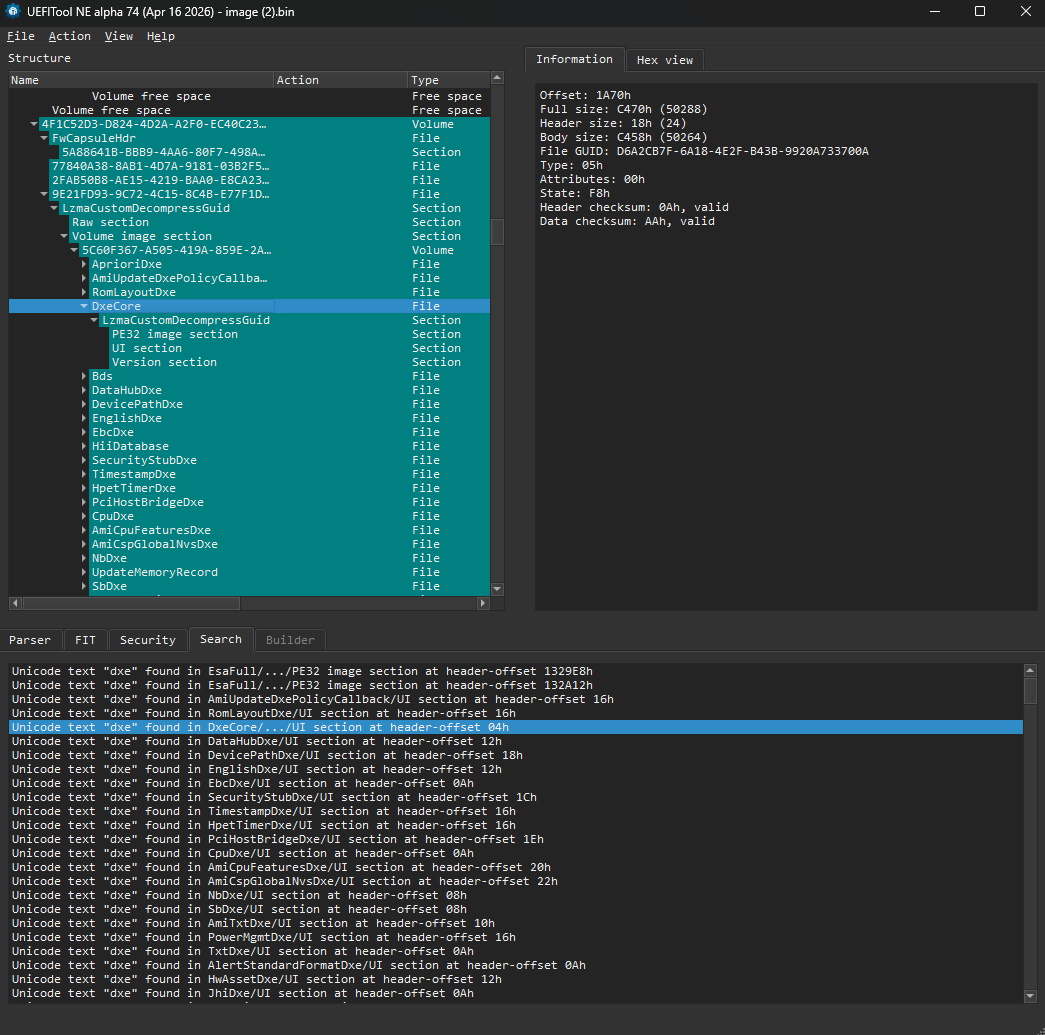
🔍 DxeCore, AprioriDxe, SecurityStubDxe – key modules for analysis
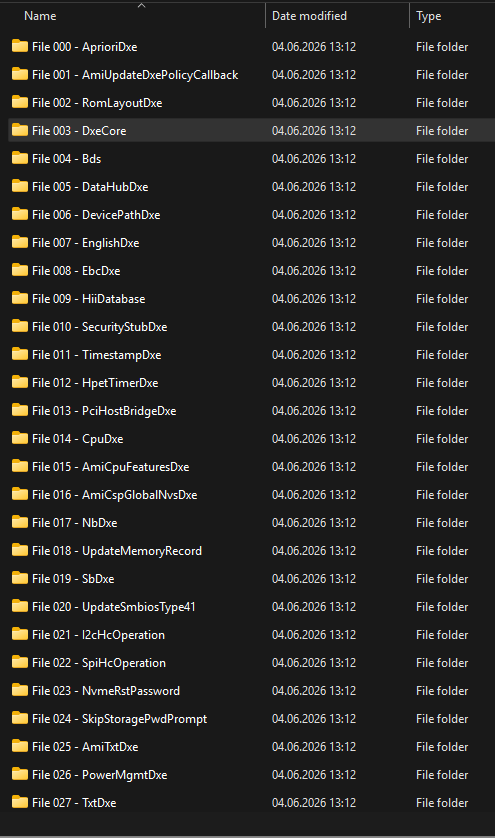
🔍 25+ drivers: AprioriDxe, DxeCore, Bds, CpuDxe, NbDxe, SbDxe
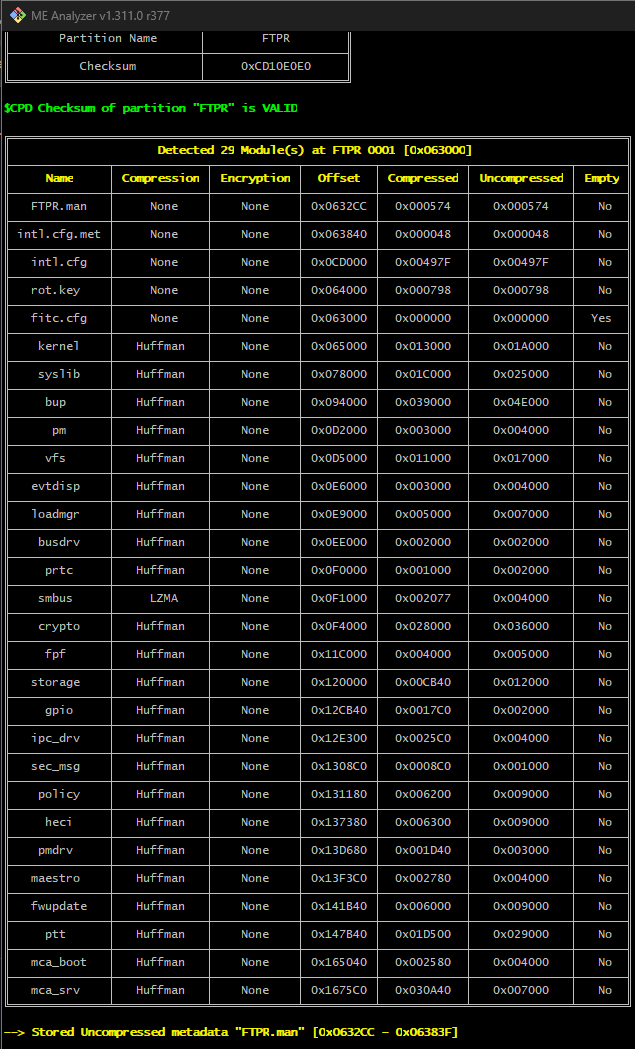
🔍 kernel (76KB), crypto (216KB), ptt (164KB – software TPM), fwupdate, heci
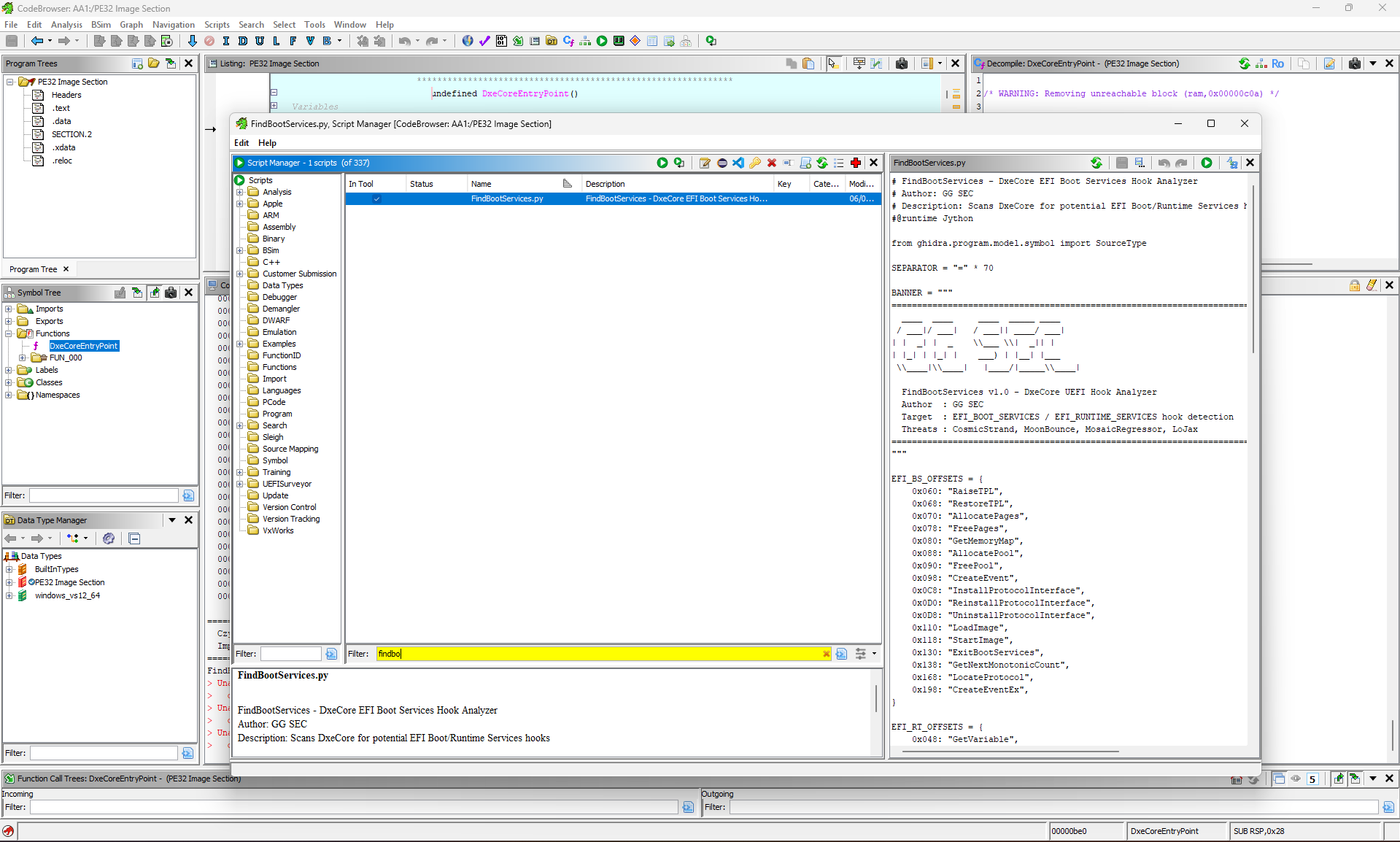
🔍 GG SEC custom script: FindBootServices – scans DxeCore for EFI_BOOT_SERVICES hooks
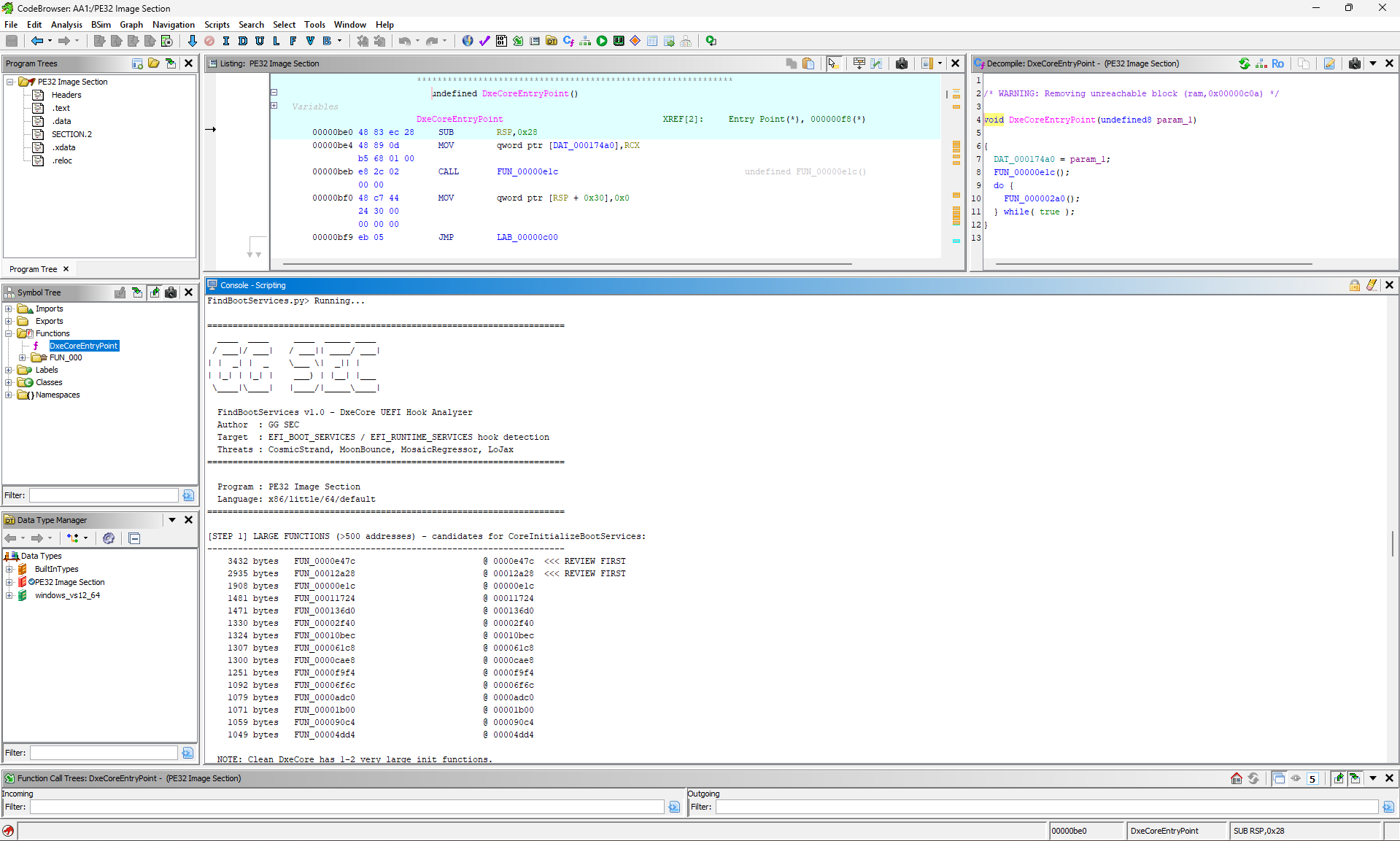
🔍 FindBootServices.py output – detected potential hooks in EFI_BOOT_SERVICES table (offsets: RaiseTPL, AllocatePages, ExitBootServices, LocateProtocol, CreateEventEx, GetVariable)
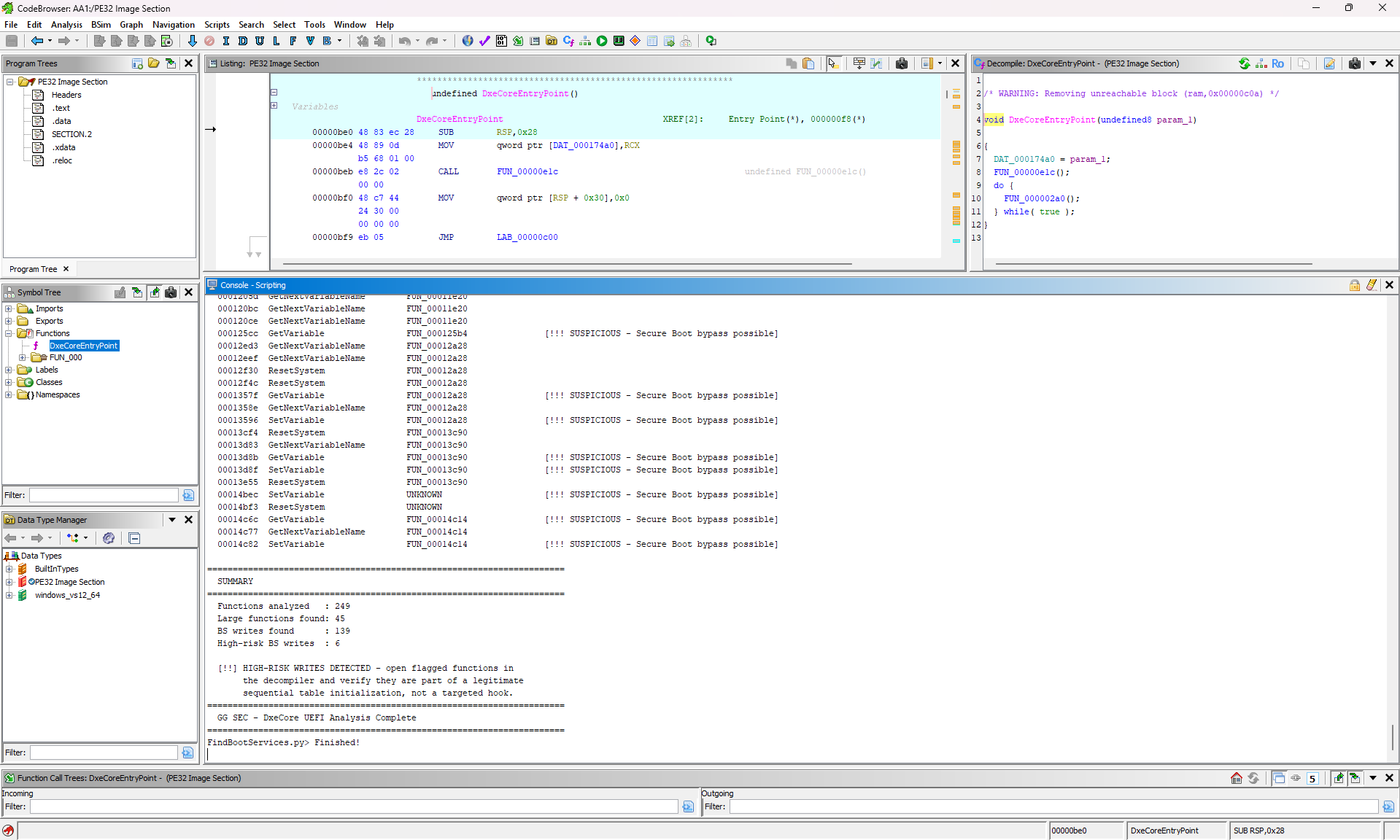
🔍 FindBootServices.py detailed scan – DxeCoreEntryPoint analysis, GetVariable, GetNextVariableName calls
DXE Driver Deep Dive – BiosGuard, Hooking & Boot Services Manipulation
10.1 DXE Driver Loading Order – AprioriDxe
| Driver | Purpose | Security Relevance |
|---|---|---|
| DataHubDxe | Data hub for system information | Low – info gathering |
| CpuDxe | CPU initialization, SMM setup | HIGH – SMM entry point |
| PciHostBridgeDxe | PCI host bridge | Medium – DMA attack surface |
10.2 BiosGuardDxe – Critical Security Driver
10.3 Critical DXE Drivers for Security Research
| Driver | Why Important |
|---|---|
| DxeCore | PRIME TARGET – CosmicStrand, MosaicRegressor hook DxeCore |
| SmmCore / *Smm* | HIGHEST PRIVILEGE (Ring -2) — target of SMI handler vulnerability classes such as CVE-2020-24489. Not a BlackLotus target; BlackLotus does not interact with SMM. |
| BiosGuardDxe | Bypass = unrestricted flash write |
10.4 EFI Boot Services Hooking
| Service | When Hooked | Known Malware |
|---|---|---|
| ExitBootServices | Execute payload before OS | CosmicStrand |
| AllocatePages | Allocate hidden memory | MoonBounce |
| CreateEventEx | Schedule malicious callback | MosaicRegressor |
10.5 Indicators of Compromise (IoC) – DXE Level
| Indicator | Typical of |
|---|---|
| Write to gBS→ExitBootServices pointer | CosmicStrand |
| CreateEventEx with unknown GUID | MosaicRegressor |
| Jump to address outside PE range | Generic implant indicator (MoonBounce, MosaicRegressor) |
SMM Deep Dive – Ring -2 & System Management Mode
System Management Mode (SMM) is the highest privilege level in x86/x64 – Ring -2, beyond hypervisor (Ring -1) and kernel (Ring 0). SMM code executes in response to System Management Interrupts (SMIs) and can access all system memory, including hypervisor and kernel space.
11.1 SMM Architecture – Attack Surface
| Component | Attack Surface |
|---|---|
| SMI (System Management Interrupt) | Malicious SMI generation → forced entry |
| SMI Handler | Buffer overflow → arbitrary SMM code |
| SMRAM (SMM RAM) | SMRAM cache poisoning, lock bypass |
| SMM Communication Protocol | Buffer manipulation → SMM memory corruption |
| SW SMI (I/O port 0xB2) | Unprivileged SMI generation → DoS / code execution |
11.2 Documented SMI Handler Vulnerability Classes
| Class | Mechanism | Representative CVE |
|---|---|---|
| SMI handler buffer overflow | Attacker-controlled data in the SMM communication buffer overruns handler-local storage, yielding code execution in SMRAM | CVE-2020-24489 |
| SMM callout | An SMI handler dereferences a pointer into memory outside SMRAM that the attacker controls, executing non-SMRAM code at Ring -2 | Multiple vendor-specific |
| SMRAM lock bypass | D_LCK / SMRR left unset, permitting direct SMRAM access from Ring 0 | Configuration weakness |
| SMM cache poisoning | MTRR manipulation causes SMRAM fetches to resolve from attacker-controlled cache lines | Legacy platforms |
11.3 SMM Detection Methodology
python chipsec_util.py smi scan
python chipsec_util.py smm info
python chipsec_util.py smm compress
python chipsec_main.py -m common.smm
python chipsec_util.py smm smram_lock
- CVE-2020-24489 – Intel – SMI handler buffer overflow
- CVE-2025-4275 – “Hydroph0bia” – Insyde H2O firmware; relevant to OEM notebook fleets
- Vendor-specific SMM callout issues – track via INTEL-SA / AMD-SB advisories per platform
11.4 SMM Indicators of Compromise (IoC)
| Indicator | Detection |
|---|---|
| Unexpected SMI handler | SMI handler enumeration |
| SMRAM cache poisoning | SMM integrity check (CHIPSEC) |
| SW SMI from unprivileged code | I/O port 0xB2 monitoring |
| SMRAM lock bypass | Register check (SMRR, SMM_ACCESS) |
- Enable SMM page table protection (BIOS setting)
- Lock SMRAM after initialization (D_LCK bit)
- Limit SMI sources (USB, PCIe hotplug)
- Use CHIPSEC to verify SMM integrity regularly
The 2026 Secure Boot Trust Anchor Transition
Microsoft’s Secure Boot certificates issued in 2011 reach expiry in June 2026. This is the first refresh of the Secure Boot chain of trust since its introduction, and it changes the operational picture for every fleet in scope of this paper.
Why it matters operationally
| Certificate | Role | Consequence of expiry without replacement |
|---|---|---|
| Microsoft Corporation KEK CA 2011 | Key Exchange Key — authorises DB and DBX updates | Device can no longer receive new revocations. The DBX freezes at its current state permanently. |
| Microsoft Windows Production PCA 2011 | Signs the Windows boot chain | Newly signed boot components will not validate on un-updated firmware |
| Microsoft Corporation UEFI CA 2011 | Third-party signing (shim, option ROMs, vendor tooling) | Third-party boot components affected on the same timeline |
Assessment checklist
[System.Text.Encoding]::ASCII.GetString((Get-SecureBootUEFI KEK).Bytes) -match "2011|2023"
Get-SecureBootUEFI db | Select-Object -ExpandProperty Bytes | Measure-Object -Line
Confirm-SecureBootUEFI
# Linux
efi-readvar -v KEK
efi-readvar -v dbx | wc -l
mokutil --list-enrolled
Recommended actions
- Inventory KEK certificate issue year across the fleet — 2011 versus 2023 — before the expiry window closes
- Compare each device’s DBX against the current published UEFI revocation list; missing entries indicate a device that stopped receiving updates
- Verify firmware update availability per model; OEM support status determines whether a device can receive the 2023 trust anchors at all
- Treat end-of-support hardware that cannot accept new anchors as a separate, tracked risk population
- Note that TPM presence and BitLocker enrollment do not imply correct Secure Boot configuration — verify independently
Enterprise Implementation Roadmap
12.1 Phase 1: Assessment (Week 1-2)
- Inventory UEFI versions across fleet – Firmware version report
- Secure Boot status audit – Compliance dashboard
- Identify non-Secure Boot systems – Remediation list
- CHIPSEC scan on high-value systems – Baseline report
12.2 Phase 2: Hardening (Week 3-8)
- Enable Secure Boot enterprise-wide – Critical
- Update dbx with all known revocations – Critical
- Enable TPM + BitLocker (with PCR 0-7) – Critical
- Configure firmware write protection – High
- Disable legacy boot (CSM) – High
- Implement UEFI variable monitoring – Medium
12.3 Phase 3: Continuous Monitoring (Ongoing)
- Firmware version drift detection – Monthly
- Secure Boot attestation – Continuous (via MDE/CrowdStrike)
- CHIPSEC full audit – Quarterly (critical systems)
- UEFI variable baseline comparison – Weekly
- Option ROM scanning – Upon new device enrollment
Why GGSEC – Threat Research & Firmware Specialization
GGSEC is a specialized security research laboratory focused exclusively on firmware-level threats, embedded systems auditing, and supply chain risk assessment.
13.1 GGSEC Firmware Toolkit (ggfw)
ggfw is GGSEC’s in-house firmware analysis platform, covering SPI acquisition, offline image analysis, and platform security assessment in a single tool. It was developed after the first release of this paper and now serves as the primary instrument behind GGSEC’s firmware engagements. The analyses reproduced in §9.4 and §10 were produced with it.
| Module | Capability |
|---|---|
| Offline SPI image analysis | Full-chip image parsing with dump scope assessment — distinguishes a true full-chip dump from a BIOS-region-only capture, and reports which descriptor-declared regions are actually covered |
| Intel Flash Descriptor decode | FLMAP0/1/2, FCBA/FRBA/FMBA/FISBA decode; per-master read/write permission expansion for Host CPU/BIOS, ME and GbE; automated equivalent of the common.spi_desc access-control check |
| UEFI firmware volume walker | Top-level and nested FV enumeration with header checksum and bounds validation; FFS inventory including deleted, opaque and executable file counts; NVRAM volumes routed to variable-store analysis rather than an FFS walk |
| PE/DXE anomaly heuristics | Scores executables on host-API imports, W+X sections, entropy and packaging anomalies. Detects the Windows-subsystem PE embedded in a UEFI-subsystem module pattern common to OEM persistence modules and firmware implants (see §6.4) |
| PE/TE extraction | Extracts flagged modules for offline YARA/AV triage with CSV and JSON manifests; interesting modules are written with a .HIT extension for filtering |
| Bounded disassembly | Zydis-backed reachable-code analysis of extracted hits. Resolves string cross-references, so a suspicious string with no reachable XREF is reported as low-confidence rather than as a finding |
| UEFI variable store analysis | VSS/VSS2 store parsing, record state accounting, offline attribute policy checks, and inventory of Secure Boot targets (PK, KEK, db, dbx, SetupMode, DeployedMode) |
| ME region assessment | $FPT detection and blank-ratio analysis; identifies host-denied ME reads (FRAP/BRRA) and blocks reporting of an ME version that cannot be established offline |
| Live MEI / MKHI | Host-side ME/CSE version query where the offline image is unreadable — ggfw --mei --mei-live-only |
| Region hash inventory | Per-region SHA-256 across Descriptor, BIOS, ME, GbE, PDR plus content-inferred UEFI payload — the baseline unit for fleet drift detection |
| Firmware family & CSM analysis | Vendor family inference (AMI, InsydeH2O, Phoenix) with confidence scoring; legacy reset-vector and boot-block inspection for CSM-capable platforms |
Current release: v0.8.0 Beta. GUID identification uses an LVFS-derived bundled database.
13.2 Supporting Tooling
| Tool | Purpose |
|---|---|
| FindBootServices.py (Ghidra) | Scans DxeCore for EFI Boot/Runtime Services hooks – detects CosmicStrand, MoonBounce and MosaicRegressor style hooking |
| UEFI Volume Extractor | DXE driver extraction, hash baseline generation, anomaly detection |
| ME Analyzer Automation | ME region integrity validation, checksum verification, manifest signature validation |
| SMM Integrity Scanner | SMI handler enumeration and SMM memory analysis |
Methodology & Limitations
13.5.1 Methodology
This paper draws on vendor advisories, peer-reviewed and industry security research, conference proceedings, and first-party firmware analysis conducted by GGSEC. CVE identifiers, malware attributions and persistence mechanisms have been cross-checked against primary vendor and researcher sources rather than secondary reporting. Where the research community has not reached consensus on attribution, that uncertainty is stated rather than resolved editorially.
13.5.2 Limitations
- Offensive implementation detail — exploit code, SPI write procedures, bootkit loader internals — is deliberately omitted. This document is written for defenders, firmware auditors and security architects.
- Firmware-level attribution is technically difficult. Attributions reflect community consensus at the time of writing and should be treated as provisional.
- Heuristic detection findings, including those produced by GGSEC tooling, indicate items warranting manual review. They are not malware verdicts.
- Offline firmware analysis cannot establish runtime state. Secure Boot enablement, ME/CSE version and active service status require live host queries.
- CVE status information is time-sensitive. Verify against vendor advisories before operational use.
Appendix & References
14.1 Quick Reference Card – Windows Detection Commands
Get-UEFIVariable -Name "BootOrder"
Get-WinEvent -FilterHashtable @{LogName='Microsoft-Windows-CodeIntegrity/Operational'} | Where-Object {$_.Id -eq 3076}
Get-WmiObject -Class Win32_BIOS
14.2 Quick Reference Card – Linux Detection Commands
mokutil --sb-state
ls /sys/firmware/efi/efivars/
dmesg | grep -i "secure boot\|uefi"
14.3 Critical CVEs to Track
| CVE | Description | Status |
|---|---|---|
| CVE-2022-21894 | Baton Drop — Secure Boot bypass in Windows Boot Manager (exploited by BlackLotus) | Patched Jan 2022; revocation via KB5025885 chain |
| CVE-2023-24932 | Secure Boot bypass; Microsoft fix required manual opt-in activation | Patched May 2023 — verify enforcement is actually enabled |
| CVE-2020-10713 | BootHole — GRUB2 grub.cfg parser buffer overflow | Patched (dbx update) |
| CVE-2024-8105 | PKfail — leaked AMI test Platform Keys across 800+ device models | Vendor-dependent; audit PK provenance per device |
| CVE-2023-40238 | LogoFAIL — boot logo image parser flaws in DXE (class of CVEs) | Patch pending (vendor dependent) |
| CVE-2024-7344 | Signed UEFI application permitting unsigned code execution; abused by HybridPetya | Revoked Microsoft Patch Tuesday, Jan 2025 |
| CVE-2025-4275 | Hydroph0bia — Insyde H2O UEFI firmware | Vendor advisory; relevant to OEM notebooks |
14.4 References
- ESET Research / Smolár, M. (2023). "BlackLotus UEFI bootkit: Myth confirmed." WeLiveSecurity, 1 March 2023.
- Microsoft Security Response Center. (2023). "Guidance for investigating attacks using CVE-2022-21894: The BlackLotus campaign."
- NSA. (2023). "BlackLotus Mitigation Guide" (CSI, June 2023).
- Binarly REsearch. (2024). "PKfail: Untrusted Platform Keys undermine Secure Boot" (CVE-2024-8105).
- Kamluk, V., Belov, S., Sacco, A. (2014). "Absolute Backdoor Revisited." Black Hat USA.
- Eclypsium. (2023). "Supply Chain Risk from Gigabyte App Center Backdoor."
- Kaspersky. (2021). "MoonBounce: the dark side of UEFI firmware."
- Microsoft Security Response Center. (2023). "CVE-2022-21894 Secure Boot Security Feature Bypass Vulnerability."
- MITRE ATT&CK. (2024). "Bootkit (T1542.003)" and "System Firmware (T1542.001)."
- Binarly Research. (2023). "LogoFAIL: Image parser vulnerabilities in UEFI DXE drivers."
- Quarkslab. (2020). "The BootHole vulnerability: GRUB2 bootloader compromise."
- Google Project Zero. (2020). "CVE-2020-10713: GRUB2 BootHole."
- Intel Corporation. (2023). "CHIPSEC: Platform Security Assessment Framework."
- National Institute of Standards and Technology. (2018). "NIST SP 800-193: Platform Firmware Resiliency Guidelines."
- US-CERT. (2023). "AA23-165A: BlackLotus UEFI Bootkit."